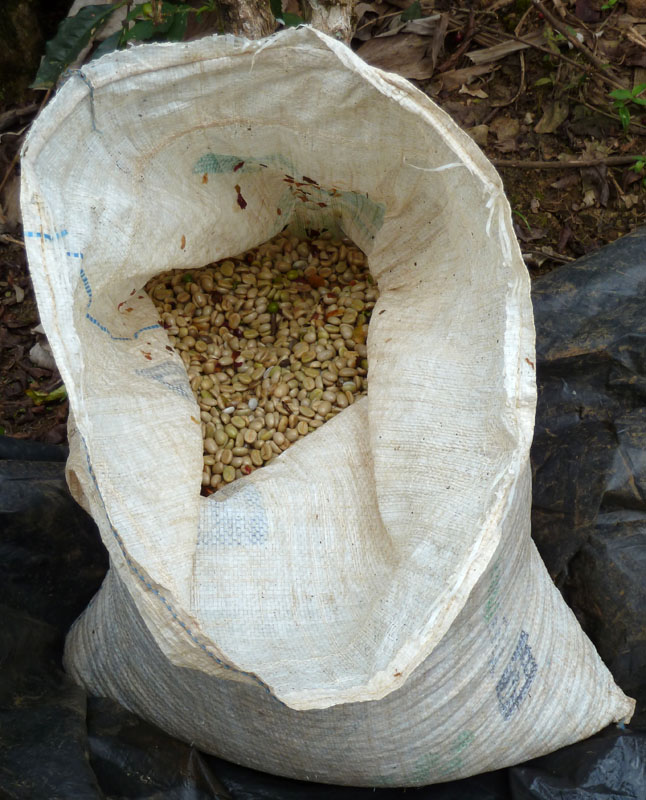
The product of coffee cherry processing is bags of wet coffee beans. These new beans are about 2/3 water. Green beans ready for roasting need to be 11 to 12% moisture, so a significant amount of water has to be removed.
While large commercial processors will use a power unit, small operations use the sun. Beans are spread out to dry. Most spread the beans on a concrete pad; Matias uses drying racks called parijuelas, traditional wood-framed mesh racks.
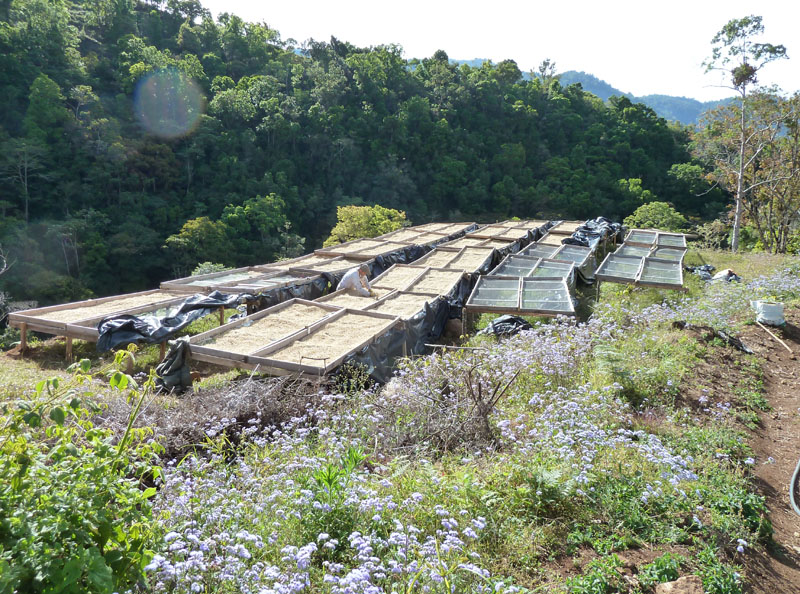
The equivalent of 10 cajuelas, half of a fanega, of cherries goes into the processor, and 4 cajeulas come out. This is poured into one parijuela. Once these dry and have their parchment removed, they will result in 54 pounds of green coffee. Each parijuela is labeled and the date is noted when a batch of fresh beans is added. The average drying time is seven days in the sun. In a labour intensive process, the wet beans must be moved around several times a day to avoid any rot or fungus growing. In the evening and during rain, the beans must be covered to avoid absorbing water. Two approaches are used here. In the picture above, black plastic sheets are connected to each Parijuela. This plastic is draped over the beans at night.

Another approach is to build a plastic tunnel to house the Parijuelas. This has several advantages.
- There is no need to manually cover and remove the plastic at night.
- The tunnel gets warmer than the outside air so drying is faster.
The down side is the tunnel is not cheap to build.

Every day, the moisture content of each parijuela is measured and logged. This is done with a moisture meter, in this case a Sinar FarmPro 6090. This unit can measure the moisture of green beans with and without parchment, as well as roasted coffee as whole bean or ground.

Once the coffee reaches the desired 11-12% moisture, it is bagged and stored to await the next step, parchment removal.
Measuring Bean Moisture with Sinar FarmPro 6090.